Building a dental office in Tulsa in 2026 costs $300–$500+ per square foot (construction plus equipment), with a standard 1,800 SF, 3-chair clinic averaging $591,000. The full process — from planning to move-in — takes 6 to 12 months. Dental offices require specialized MEP systems that standard commercial contractors often get wrong: under-slab plumbing for chair outlets, medical-grade compressed air, nitrous oxide piping, infection control HVAC, and lead-lined X-ray rooms. This guide covers everything: updated cost data, a phase-by-phase timeline, expert design advice from industry leaders, and the critical local SEO steps to launch your Tulsa practice with maximum visibility.
Why Dental Office Construction Is Different
Building a dental office goes far beyond a standard commercial build-out. Every operatory requires a complex web of specialized mechanical, electrical, and plumbing (MEP) systems that most commercial contractors have never encountered — under-slab plumbing for chair drainage, medical-grade compressed air and vacuum lines, nitrous oxide and oxygen piping to NFPA 99 standards, and infection control HVAC with negative-pressure sterilization rooms.
A single dental chair position requires approximately 37 individual utility connections — from hot and cold water supply, drain, air, vacuum, and electrical circuits to data cabling for digital sensors and intraoral cameras. Multiply that by 4 to 8 operatories and the infrastructure complexity becomes clear. Getting this wrong means tearing up concrete to fix under-slab plumbing — an expensive mistake that can delay your opening by months.
This guide is written specifically for Tulsa, Oklahoma dental professionals planning to build a new practice or relocate an existing one in 2026. We cover real costs, realistic timelines, expert design principles, and the local SEO groundwork you should be laying during construction — not after.
2026 Cost Expectations for Tulsa
Based on 2026 market data and UDGOK's extensive project history across 100+ dental facilities in Oklahoma and Texas.
Dental office construction currently costs between $300 and $500+ per square foot, which includes both construction and specialized dental equipment. For context, building out an empty commercial shell without dental-specific infrastructure starts around $200 per square foot. The extra cost comes entirely from dental-specific MEP: operatory plumbing, medical gas, infection control HVAC, lead shielding, and equipment power infrastructure. A standard 1,800-square-foot, 3-chair clinic averages $591,000 total project cost according to current industry benchmarks.
← SWIPE TO VIEW FULL TABLE →
Cost data sourced from UDGOK project history and current industry benchmarks. Actual costs vary by scope, site conditions, and market conditions. Contact UDGOK for a project-specific estimate.
Pro Tip: Equipment vs. Construction Budget
Don't confuse construction costs with total project costs. Dental equipment (chairs, imaging, sterilizers, compressors) typically adds $80,000 to $200,000+ on top of construction costs. Your budget should account for both. UDGOK coordinates directly with your equipment vendor (A-dec, Planmeca, Pelton & Crane) throughout construction to ensure precise utility placement.
The Construction Timeline
Experts like Keystone Design Build note that a full dental office project takes 6 to 12 months from initial decision to opening day. Here's how that breaks down:
Initial Planning & Site Selection
1–3 MonthsSecure dental-specific commercial space, finalize lease negotiations, engage an architect experienced in healthcare facilities, and begin schematic design. This is where you lock in operatory count, specialty requirements, and core equipment decisions.
Pre-Construction & Permitting
1–2 MonthsComplete construction documents with MEP engineering, submit to the City of Tulsa for building permits, finalize your general contractor, and order long-lead equipment such as dental chairs, cabinetry, compressors, and imaging systems.
Active Construction
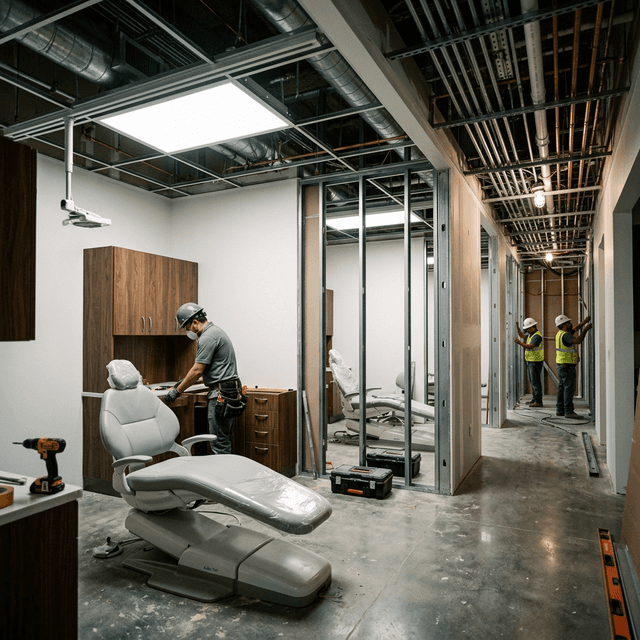
4–8 MonthsDemolition (if applicable), framing, rough-in for all MEP systems — including dental-specific plumbing under-slab, medical gas piping, infection control HVAC, and electrical for digital imaging. Drywall, finishes, cabinetry installation, and equipment rough-in follow.
Finishing & Move-In
1–2 MonthsFinal inspections, fire marshal sign-off, certificate of occupancy, dental equipment installation and calibration, IT/network configuration, staff training on facility systems, and furniture installation before opening day.
Expert Insights on Design
“Patient flow should drive every design decision. The operatory layout, sterilization center location, and staff circulation paths must all work together seamlessly. Centralizing the sterilization room with direct access from every operatory wing eliminates bottlenecks and keeps your team productive all day.”
Patient flow is the foundation of dental office design. As Jason Drewelow, CEO of Primus Companies and author of Making the Right Impression, emphasizes: the layout should naturally guide patients from reception through treatment with minimal confusion or backtracking. In a well-designed dental office, patients never cross paths with clinical staff carrying instruments, and the sterilization workflow is invisible to patient-facing areas.
Centralize your sterilization center. The sterilization room is the operational heart of a dental practice. Position it centrally with direct pass-through access to operatory wings on both sides. This eliminates wasted staff steps (the average dental assistant walks 4+ miles per shift in a poorly designed office) and ensures instrument turnaround time stays under 15 minutes between patients.
Design for expansion from day one. Even if you're starting with 3–4 operatories, your construction plan should rough-in plumbing and electrical for future treatment rooms. Adding operatories later without pre-planned infrastructure means cutting concrete, relocating plumbing, and potentially closing during renovations. The cost to rough-in future operatories during initial construction is a fraction of retrofitting later.
Local SEO & Your New Build
Crucial step: Don't wait until opening day to think about local search. Start building your digital presence while the clinic is still under construction.
Claim Your Google Business Profile Early
Claim and verify your Google Business Profile (GBP) for the new Tulsa address as soon as you have a signed lease — even if construction hasn't started. GBP verification can take 2–4 weeks, and Google rewards profiles with longevity. Select “Dentist” as your primary category and add “Dental Clinic” and “Cosmetic Dentist” as secondary categories.
NAP Consistency Across Directories
Ensure strict NAP (Name, Address, Phone) consistency across all local directories — Yelp, Healthgrades, Zocdoc, Vitals, local chamber of commerce, Oklahoma Dental Association, and insurance provider networks. Even slight variations (“Suite 100” vs. “Ste. 100”) confuse search engines and dilute local ranking signals.
Implement LocalBusiness Schema Markup
Add LocalBusiness schema markup (specifically the Dentist type) to your website's contact page. This structured data tells search engines exactly where your practice is, what services you offer, and your hours — giving you a ranking advantage before you even see your first patient.
Dental Office Construction FAQ — Tulsa, Oklahoma
How much time does it take to build a dental office in Tulsa?
▾What is the average size of a modern dental office?
▾How much does it cost to build a dental office in the U.S. in 2026?
▾Ready to Break Ground on Your Dream Practice?
Contact our Tulsa dental construction experts today for a free site evaluation and 2026 cost estimate. Most estimates delivered within 48 hours.