AI & Robotic Surgery in 2026
By 2026, AI-enabled robotic surgery has moved beyond assisted tooling into genuine autonomy — an AI system trained on 17 hours of video performed the first fully autonomous gallbladder removal in July 2025. Intercontinental robotic telesurgery was successfully demonstrated from France to India. These systems deliver reduced blood loss, shorter hospital stays, and fewer complications compared to traditional surgery. For construction, this transformation demands IEC 60601-1 compliant power infrastructure, redundant electrical systems, and purpose-built surgical suites — the exact facilities UDGOK designs and builds.
By 2026, artificial intelligence and robotic systems are transforming surgical practices — shifting care from isolated tasks to seamlessly integrated, highly precise, and increasingly autonomous workflows.
Enhanced Clinical Outcomes and Surgeon Ergonomics
AI-enabled robotic surgery provides surgeons with superior precision, dexterity, and visualization, which is especially beneficial for patients with obesity or complex anatomy. Compared to traditional open or laparoscopic surgeries, these robotic procedures are associated with:
- Reduced blood loss — robotic precision minimizes tissue damage
- Shorter hospital stays — patients recover faster with smaller incisions
- Fewer complications — AI-guided visualization catches anomalies in real-time
- Faster recovery times — minimally invasive approaches reduce post-operative pain
Furthermore, robotics significantly improve surgeon ergonomics, reducing the physical fatigue associated with lengthy operations. The surgeon operates from an ergonomic console rather than standing hunched over the patient, extending career longevity and improving focus during complex procedures.
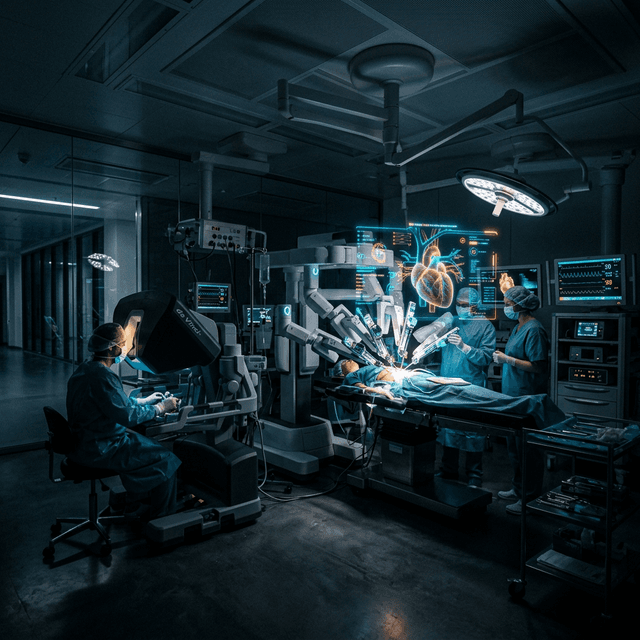
A surgeon operates with collaborative robotic (cobot) assistance — AI-guided arms provide real-time precision support during complex procedures.
Seamless Care Integration and Real-Time Analytics
AI is breaking down clinical silos by weaving preoperative diagnostics, intraoperative guidance, and postoperative monitoring into a coordinated, real-time system. This represents a fundamental shift from fragmented care to a continuous digital thread that follows the patient from imaging suite to operating room to recovery.
In the operating room, advanced imaging provides rapid 3-D reconstructions, while AI-driven algorithms offer real-time analytics and guidance to support intraoperative decision-making. Surgeons can overlay preoperative CT or MRI data directly onto the live surgical field, creating an augmented reality that highlights critical structures like blood vessels and nerves that must be preserved.
AI doesn't replace the surgeon's judgment — it amplifies it. Real-time tissue analysis, anomaly detection, and predictive modeling give the surgical team superhuman awareness during the most critical moments.
The Emergence of Autonomous Surgery
Surgical robotics are moving beyond human-assisted tools into the realm of autonomy. The milestones achieved in 2025–2026 represent a paradigm shift in what machines can do in the operating room:
- July 2025: An AI system trained on 17 hours of video successfully conducted the first realistic surgery performed autonomously by a machine — a gallbladder removal
- Dental autonomy: Fully automated robotic dental procedures have been successfully performed on humans, eliminating human variability in routine procedures
- Experimental milestones: Autonomous surgical robots are demonstrating proficiency in knee replacements, bowel anastomosis, and phlebotomy
The trajectory is clear: by 2030, autonomous surgical systems will handle an increasing share of routine, well-defined procedures, freeing surgeons to focus on complex cases requiring human judgment and adaptability.
Fully automated robotic surgical systems performing precision procedures autonomously — the breakthrough milestone of 2025–2026.
Telesurgery and Advanced Training
Robotics and AI are expanding global access to surgical expertise, eliminating geography as a barrier to world-class care.

Intercontinental telesurgery: a surgeon in France remotely performs cardiac surgery on a patient in India via high-bandwidth robotic network.
In 2025, the world's first intercontinental robotic cardiac telesurgery was successfully conducted remotely from France to an operating room in India. This landmark achievement proved that surgical expertise can be delivered anywhere on the planet where the infrastructure exists to support it.
Alongside telesurgery, remote tele-proctoring allows experienced surgeons to mentor those in underserved regions, bridging the specialist gap that affects billions of people worldwide. For trainees, AI-driven virtual reality (VR) simulation environments allow them to practice on lifelike cases, accelerating proficiency and reducing operative times before they ever enter a real clinical setting.
New Infrastructure and Governance Demands
To support this high-tech transformation, healthcare facilities are being forced to radically update their infrastructure. The construction implications are massive — and this is exactly where UDGOK's expertise becomes critical.
Power systems: Surgical robots require highly reliable, medical-grade power systems (such as IEC 60601-1 compliant structures) to prevent catastrophic power failures during procedures. A robotic system failure mid-surgery is a life-threatening event. Facilities need:
- Redundant electrical feeds from separate utility sources
- Uninterruptible power supplies (UPS) rated for surgical robot loads
- Isolated power panels per OR with line isolation monitors
- Emergency generator backup with <10 second automatic transfer
- Dedicated 3-phase 208V circuits for robotic surgical systems
Network infrastructure: Telesurgery demands ultra-low-latency, high-bandwidth connectivity. Facilities supporting remote surgery need dedicated fiber pathways, redundant network connections, and cybersecurity frameworks that protect patient data during live surgical transmission.
Regulatory frameworks: The rise of AI and remote surgery has sparked the need for entirely new regulatory frameworks to address ethical considerations, standard of care, and legal accountability when a patient's life is on the line. Healthcare facility builders must stay ahead of these evolving requirements.
UDGOK designs and constructs the surgical environments that make this future possible — from IEC 60601-1 compliant power infrastructure to reinforced OR floors and dedicated robotic storage. Contact us to discuss your next-generation surgical facility.
Frequently Asked
AI robotic surgery combines artificial intelligence algorithms with robotic surgical systems to provide surgeons with enhanced precision, real-time analytics, and 3D visualization. The robotic arms can perform movements at scales impossible for the human hand, while AI provides intraoperative guidance, anomaly detection, and autonomous tissue identification.
Yes. In July 2025, an AI system trained on 17 hours of surgical video successfully performed the first realistic autonomous gallbladder removal. Fully automated robotic dental procedures have also been successfully performed on humans. Autonomous systems are in experimental phases for knee replacements, bowel anastomosis, and phlebotomy.
Telesurgery is the performance of surgery by a surgeon who is physically remote from the patient, controlling a robotic surgical system over a network connection. In 2025, the world's first intercontinental robotic cardiac telesurgery was conducted remotely from France to India, demonstrating that geography is no longer a barrier to surgical expertise.
Surgical robots require IEC 60601-1 compliant medical-grade power systems to prevent catastrophic failures during procedures. This includes redundant electrical feeds, uninterruptible power supplies (UPS), isolated power panels, and emergency generator backup with <10 second transfer times. UDGOK builds these systems into every surgical facility we deliver.
Facilities must accommodate larger surgical suites (600–1,000 SF), reinforced floors for robot weight (some systems weigh 1,500+ lbs), dedicated 3-phase 208V power circuits, high-bandwidth low-latency network infrastructure for telesurgery, and specialized HVAC for equipment heat loads. UDGOK designs and constructs these next-generation surgical environments.